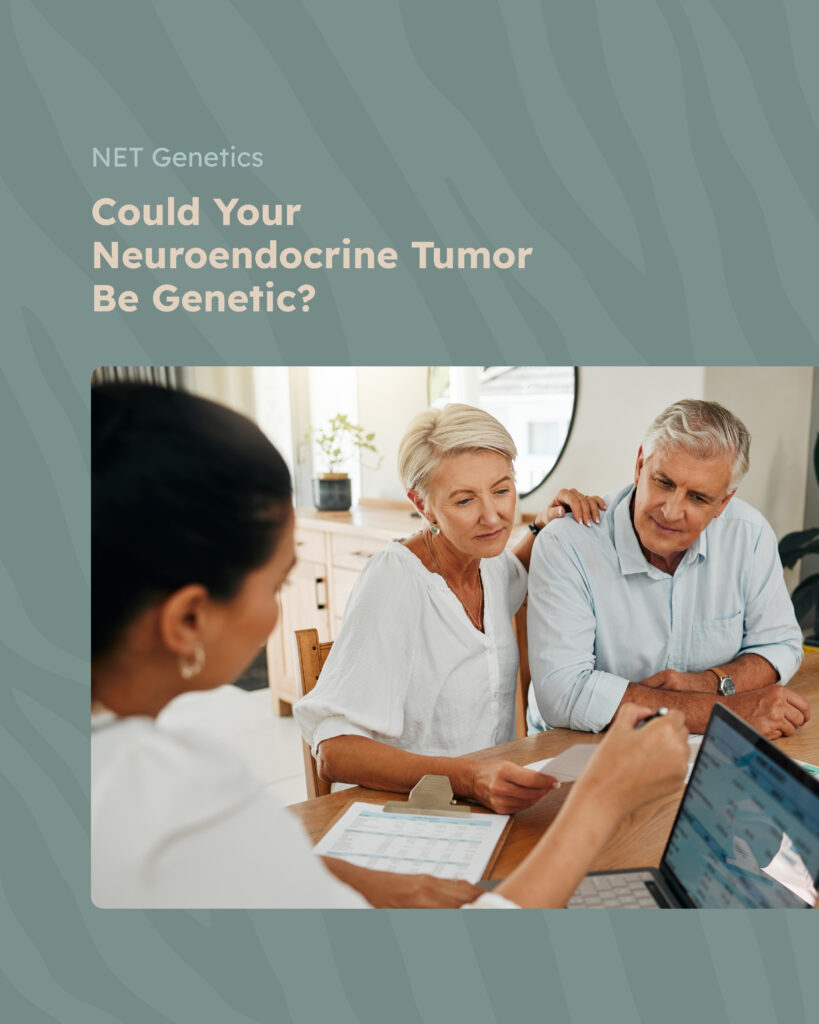
When someone is diagnosed with a neuroendocrine tumor (NET), one of the first questions that often follows is: “Why did this happen?”
For many patients with NETs, there is no clear answer, but, in some cases, genetics may play a role. While most neuroendocrine tumors are considered sporadic, a small percentage are associated with inherited genetic syndromes that can increase a person’s risk of developing NETs and other cancers. Understanding whether a NET may have a hereditary component can help guide treatment decisions, inform family members about potential risks, and provide valuable insight into long-term health management.
Are Neuroendocrine Tumors Hereditary?
Most neuroendocrine tumors are not inherited, but certain hereditary syndromes are known to increase the likelihood of developing NETs, because they are caused by genetic mutations that can be passed from parent to child.
If a hereditary syndrome is present, family members may also benefit from genetic counseling, testing, or additional screening.
What Does It Mean for a NET to Be Hereditary?
A hereditary NET occurs when a person inherits a genetic mutation that increases their risk of developing neuroendocrine tumors. These inherited mutations are present from birth and can be passed through families across generations. In many hereditary cancer syndromes, an individual who carries the mutation has a 50% chance of passing it to each child.
It’s important to note that inheriting a mutation does not guarantee that cancer will develop, just that the risk may be higher than in the general population.
Three Common Genetic Syndromes Associated with NETs
Multiple Endocrine Neoplasia Type 1 (MEN1)
MEN1 is one of the most common hereditary syndromes associated with neuroendocrine tumors.
This condition can affect multiple endocrine organs, including:
- The pancreas
- The pituitary gland
- The parathyroid glands
Patients with MEN1 may have an increased risk of developing pancreatic neuroendocrine tumors and other endocrine-related tumors.
Multiple Endocrine Neoplasia Type 2 (MEN2)
MEN2 is associated with several endocrine cancers and tumors, including:
- Medullary thyroid cancer
- Pheochromocytoma
- Other endocrine tumors
Because some forms of MEN2 can develop early in life, identifying the syndrome can be important for screening and preventive care.
Von Hippel-Lindau Syndrome (VHL)
Von Hippel-Lindau syndrome, commonly known as VHL, is another hereditary condition linked to NET development.
VHL may be associated with:
- Pancreatic neuroendocrine tumors
- Kidney cancers
- Adrenal tumors
- Tumors affecting the brain and spinal cord
Interestingly, approximately 20% of VHL cases occur without a known family history, underscoring that genetic evaluation can still be helpful even when no obvious hereditary pattern exists.
When Should Patients with NETs Consider Genetic Testing?
Not every patient with a neuroendocrine tumor needs genetic testing. However, NET specialists may recommend genetic counseling or testing when certain risk factors are present.
Common reasons include:
- A family history of NETs or unusual tumors
- Diagnosis at a younger age
- Multiple tumors
- Recurrent tumors
- Pancreatic neuroendocrine tumors
- Pheochromocytoma or paraganglioma diagnoses
- Multiple family members with endocrine-related cancers
A genetics professional can help determine whether testing may be appropriate and explain what the results could mean for both the patient and their family.
Why Genetic Testing Matters
Learning that a NET may be hereditary can feel overwhelming at first.
Yet for many families, knowledge creates opportunity.
A genetic diagnosis may help:
- Guide surveillance and screening
- Inform treatment decisions
- Identify risks for family members
- Enable earlier intervention when appropriate
- Provide clarity about the cause of a diagnosis
Advances in genetic testing and hereditary cancer research continue to improve healthcare teams’ ability to identify risk and develop proactive monitoring plans.
A Patient Perspective: Living with VHL
For many people, hereditary cancer syndromes are more than a medical diagnosis. They are part of daily life.
As Lupe, a patient living with VHL, shared:
“If you feel that something’s not right, keep pushing to get scans because your body’s trying to tell you something.”
Stories like Lupe’s remind us that advocacy, education, and persistence can play an important role in navigating complex diagnoses.
Frequently Asked Questions About NET Genetics
What percentage of neuroendocrine tumors are hereditary?
Most NETs are not hereditary. However, a subset is associated with inherited genetic syndromes, including MEN1, MEN2, and VHL.
Can a parent pass a NET-related mutation to a child?
Yes. Many hereditary cancer syndromes follow an autosomal dominant inheritance pattern, meaning there is often a 50% chance of passing the mutation to a child.
Does a hereditary mutation mean I will definitely develop cancer?
No. A genetic mutation increases risk but does not guarantee that cancer will occur.
Should my family members be tested?
That depends on the specific mutation, family history, and recommendations from a genetics professional. Genetic counseling can help families understand their options.
Knowledge Creates Clarity
For patients with NETs and their loved ones, understanding hereditary risk can be an important step toward informed decision-making.
Whether genetic testing confirms an inherited syndrome or rules one out, the information gained can help patients work with NET specialists to make informed decisions about screening, treatment, and family health.
If you have questions about NET genetics, hereditary cancer syndromes, or whether genetic counseling may be appropriate for you or a loved one, FLaNET is here to help. Through patient education, expert insights, community resources, and ongoing support, our goal is to help patients with NETs navigate every stage of the journey with greater clarity, connection, and hope.